


Indore Pears: Two Diamonds, a Maharaja & a Murder
There are two pear-shaped diamonds, each nearly 47 carats, that have spent the last hundred years changing hands. They have hung from a Maharaja’s neck and been reset by two Paris houses. They sat in a New York vault, went to a Philadelphia collector, and came back to the same vault more than once, before leaping across continents once again.
They’re called the Indore Pears. Most people have never heard of them, even people who love Indian jewelry. But their journey across a century, continents, and several generations is a reminder that sometimes the story of a jewel matters just as much as the stone itself.
A Maharaja in a Paris Salon
The first chapter begins with Tukoji Rao Holkar III, who had ruled Indore since 1903. Like many princes of his generation, he moved between two worlds. At home he was the head of a Maratha dynasty. In Europe he was one of the best customers of the great jewelry houses, buying from Chaumet, Cartier and Boucheron.
In 1913, on one of those trips to Europe, he walked into Chaumet’s boutique in Paris looking for a present for his wife.
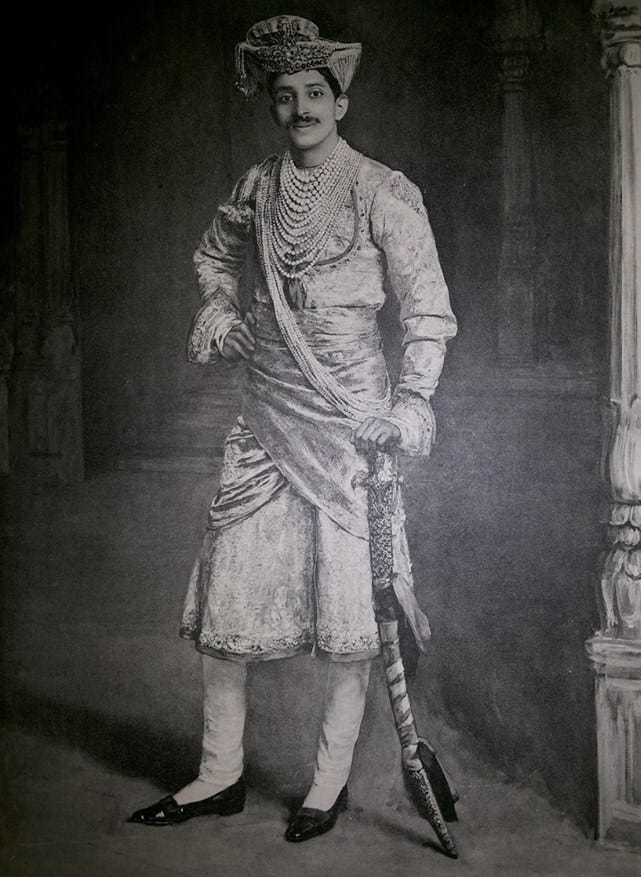
Maharaja Tukoji Rao Holkar III
Chaumet showed him two pear-shaped diamonds of almost 47 carats each, 46.95 and 46.70. He came back the next day to commission the necklace. The bill came to more than 631,000 francs, roughly $268,000 at the time. Chaumet set the pears in a French lavalier style, a fluid necklace with the two stones hanging at the bottom.
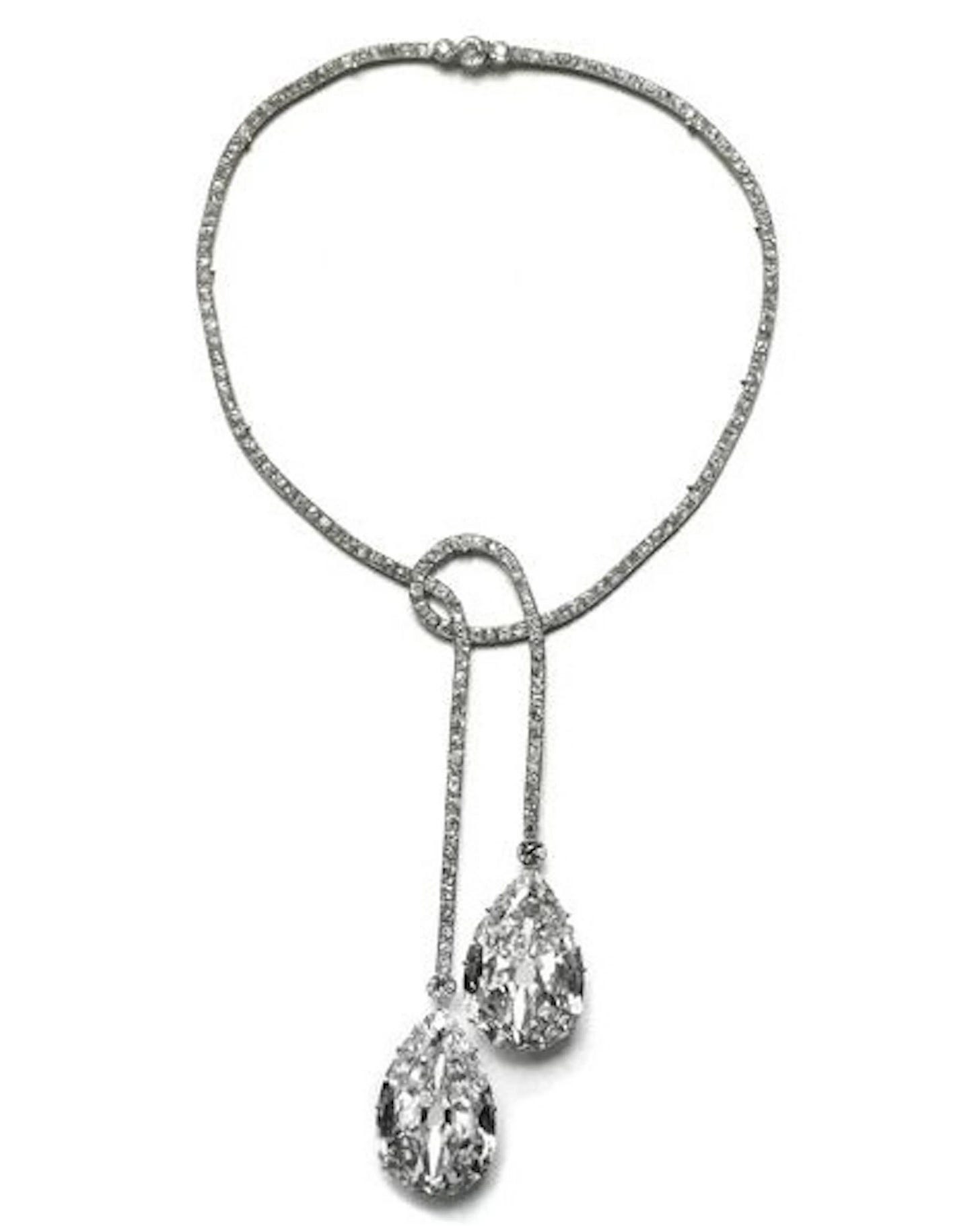
The original setting.
A Shot on Malabar Hill
In January 1925, a Bombay businessman named Abdul Kadir Bawla was driving on Malabar Hill with Mumtaz Begum. She was a courtesan who had escaped from the Maharaja’s household. Their car was stopped, and Bawla was shot in the head.
The men who were caught had links to Indore. Three of them were sentenced to death and three to life imprisonment. The Maharaja himself was never tried. But the British gave him a choice: face a public inquiry, or step down. On 26 February 1926, Tukoji Rao abdicated in favour of his seventeen-year-old son, Yeshwant Rao Holkar II.
He moved to Europe and lived mostly in France until he died in Paris in 1978. The necklace stayed with the family.
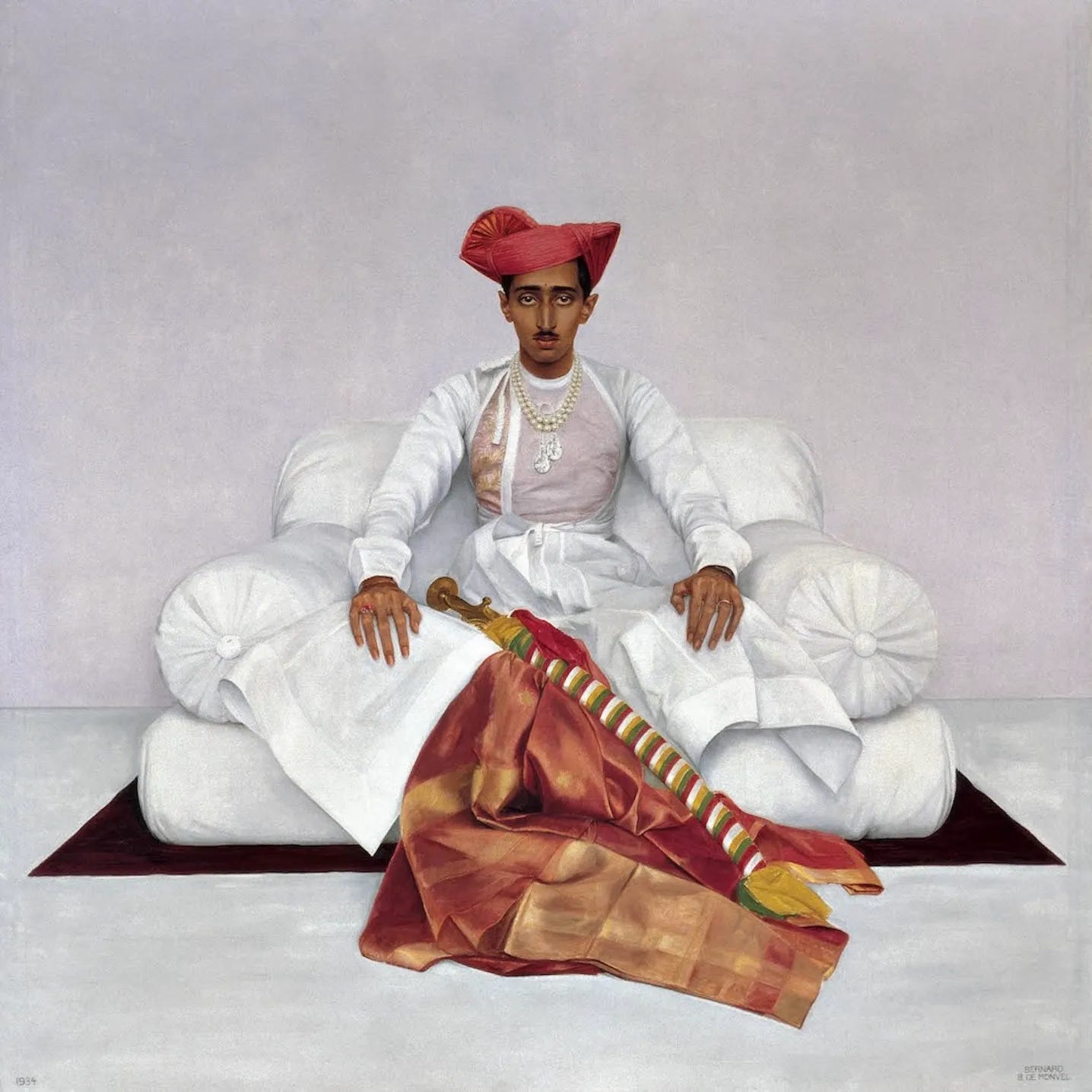
Yeshwant Rao Holkar II in the Indore Pears Necklace
Yeshwant Rao and his wife, Sanyogita Devi, decided the necklace needed to look like it was from their own time. In 1933 they took it to a different Paris house, Mauboussin. The soft, flowing lavalier became something more geometric, built around large step-cut diamonds inspired by Art Deco, the style of the moment.
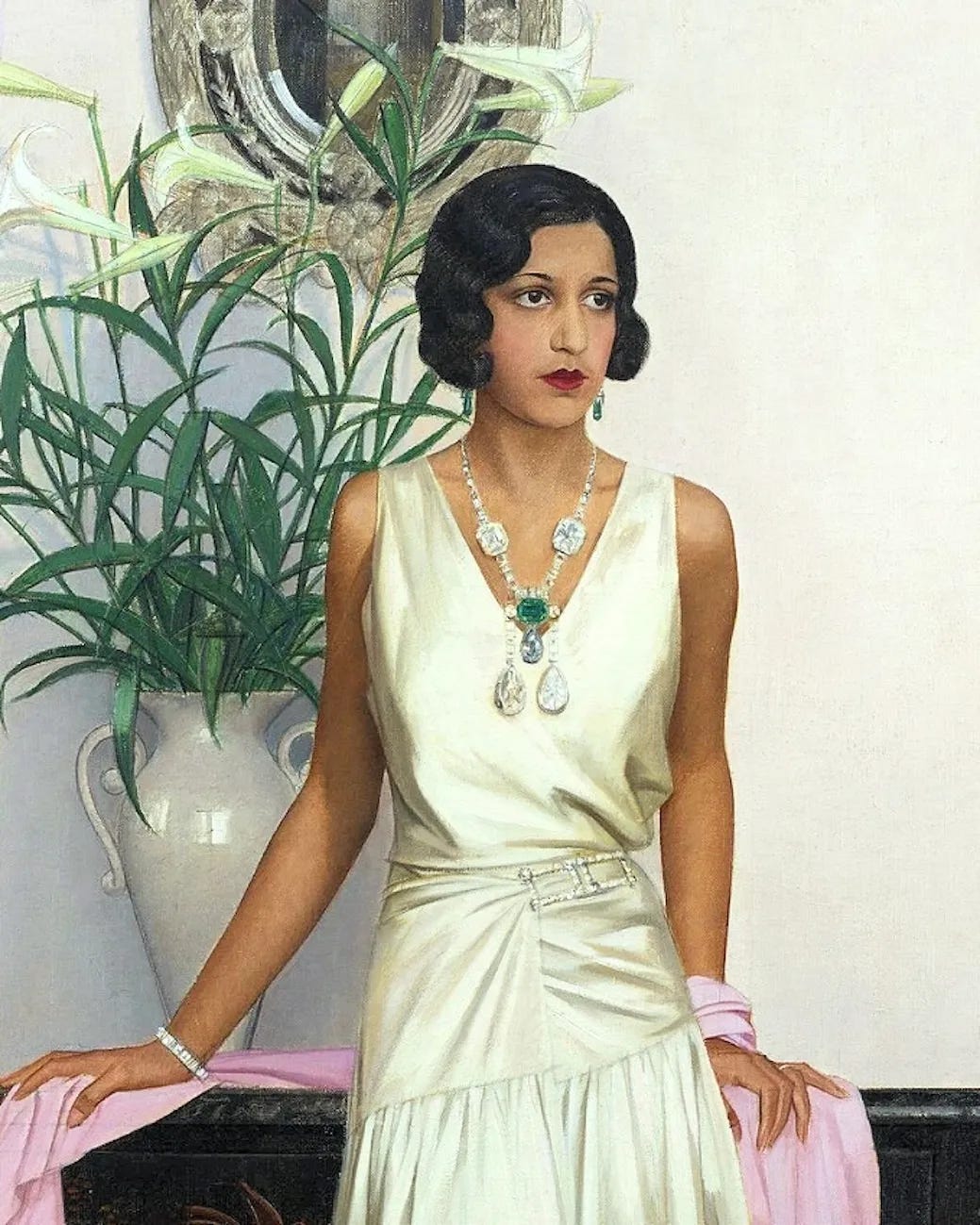
Sanyogita Devi in the re-set necklace
I love this part, because it still happens in families today. A child inherits their parent’s jewelry and doesn’t want to wear the past. So the stones stay, and the setting moves with the times.
The Jeweler Who Kept Buying Them Back
In 1946, a year before independence, Yeshwant Rao and Sanyogita Devi sold the necklace to Harry Winston. Like many princely families, they were worried about losing their treasures to the new Indian government.
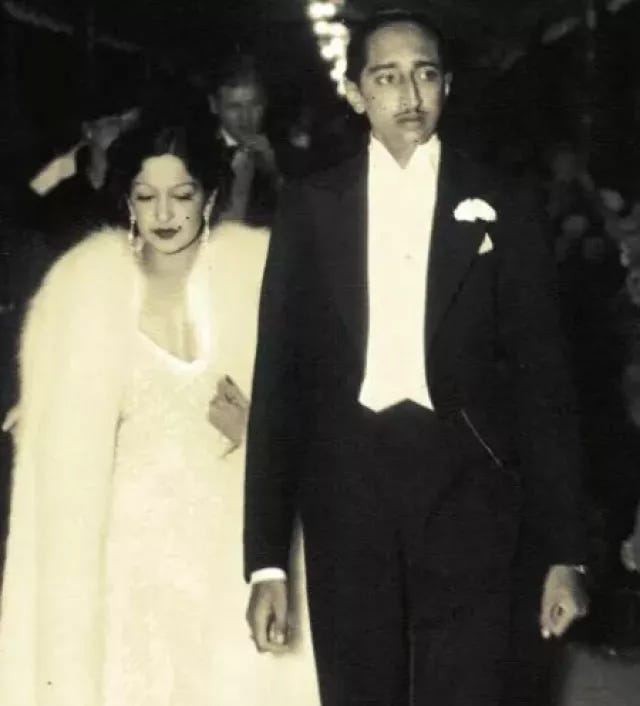
The stylish couple.
Winston recut the two diamonds to improve their brilliance, bringing them down to 46.39 and 44.14 carats. He set them in a new necklace of baguette diamonds and sent them on tour in his Court of Jewels exhibition.
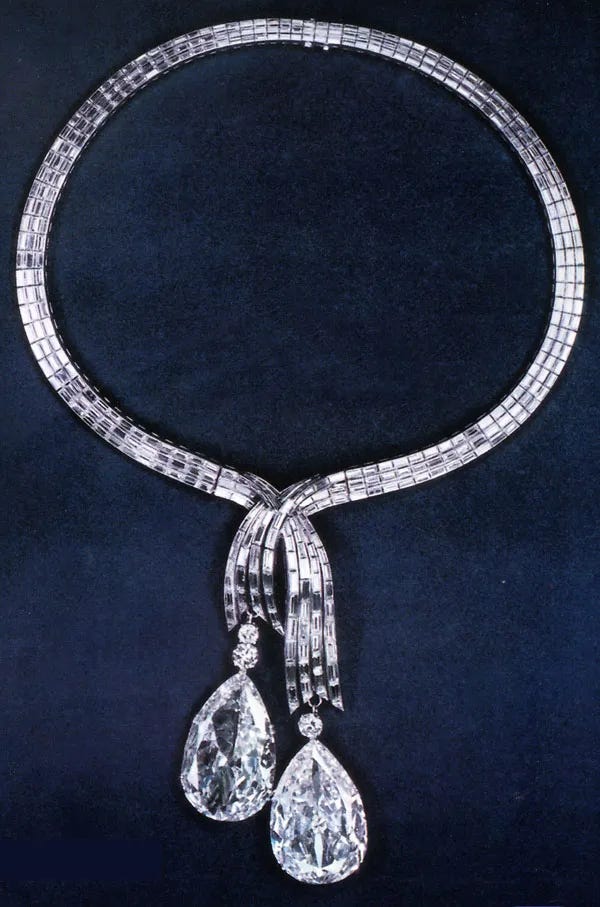
Harry Winston’s necklace
In 1951, Shirley Temple, then Mrs. Charles Black, was photographed wearing them at a charity show in Washington. Two years later, in 1953, Winston sold them to a client in Philadelphia. In 1958 he bought them back and sold them to someone in New York. In 1976 he bought them back again, and this time sold them to a member of a royal family.
I find this the most interesting part of the story. A jeweler who buys the same pair of diamonds three times isn’t just trading, he’s attached to them. Every time they came up, Winston wanted them in his hands again, even if it was only for a while.
In 1947, a year after buying the Indore Pears, Winston bought another Holkar treasure. The Maharaja of Indore necklace was renamed the Spanish Inquisition Necklace, with a made-up history about Spanish and French royalty. That one is now in the Smithsonian Museum in DC, which only acknowledged the necklace’s real history in 2021.
Where They Are Now
After passing through several more clients, the Indore Pears landed with the Lebanese jeweler Robert Mouawad. He did something none of the earlier owners had done. He took them out of a necklace altogether and set them as a pair of earrings.
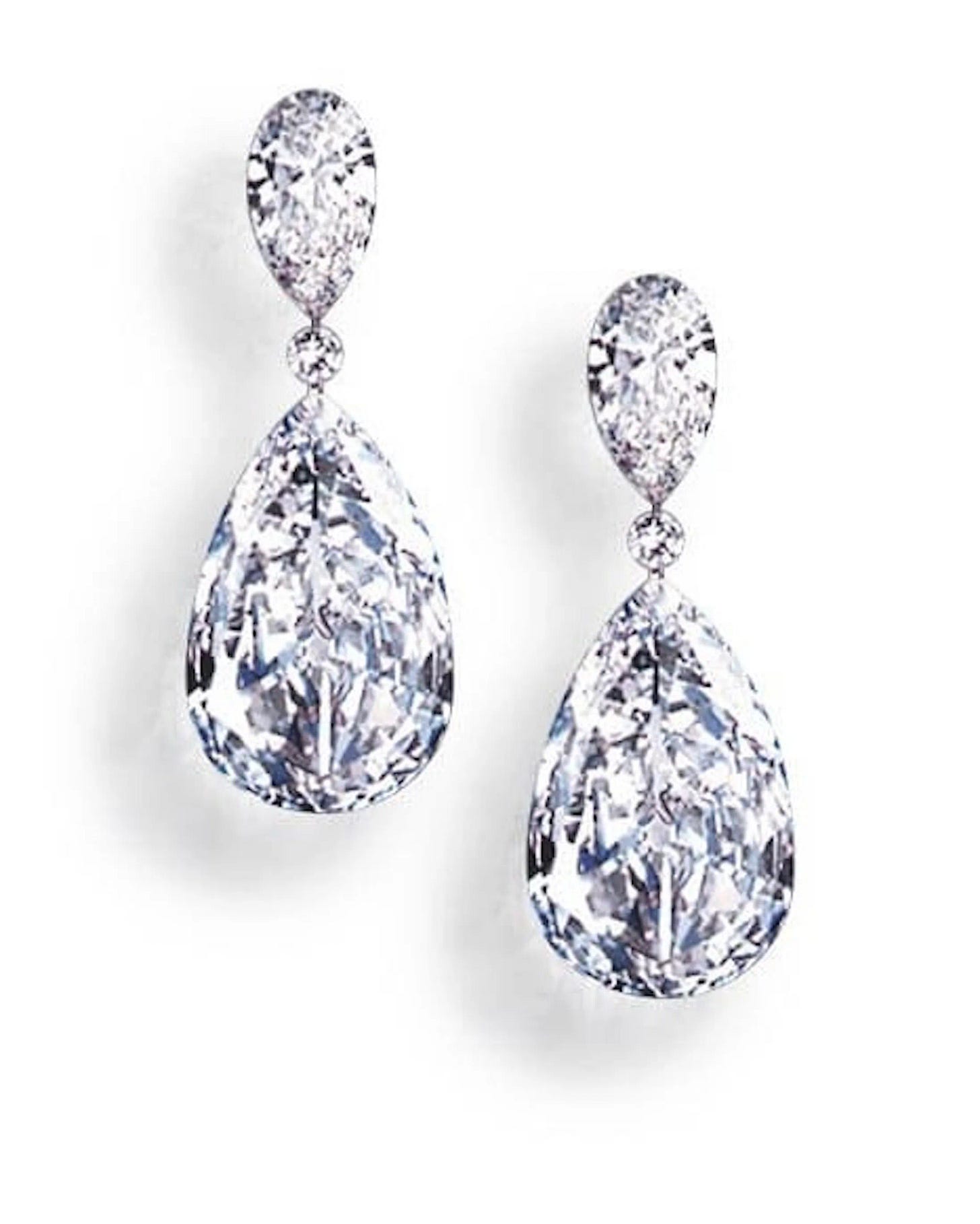
Mouawad’s Pair of Pears
And more recently, the story has come full circle. Chaumet, the house that sold the stones in 1913, now has a collection called Maharani de Chaumet, inspired by that first necklace it made for the Maharaja.
Over a hundred years, these two stones have been a lavalier, an Art Deco piece, a baguette necklace and now earrings. Their owners have been a deposed Maharaja and his son, a New York jeweler three times over, a Philadelphia collector, a royal family and a Beirut jewelry house. The stones stayed the same while everything around them kept changing.